Arab States

Arab Unions' Joint Position Paper for COP 30

Region
Arab States
Country
Arab States
Originator/Owner
Workers organizations
Coordinating/Lead actor
Collective advocacy of the following trade unions: ECTU, ETUF (Egypt), UMT, UGMT, CDT (Morocco), NLC (Nigeria), ATUC (Jordan), UGTT (Tunisia), GFWTUI (Iraq), TUC (Ghana)
Policy type
Position papers by social partners
Policy areas
Enterprise policies, Macroeconomic and growth policies, Rights, Skills development, Social dialogue and tripartism, Social protection
Environmental focus
Climate change
Target groups
Other, Women, Workers, Youth
Sectoral focus
Other
Crosscutting themes
Finance (public/private), Gender equality, Green economy, Informal economy
Date of Adoption
November 2025
Timeframe
No timeframe provided yet.

This position paper outlines the Arab trade unions’ vision for integrating a just transition into NDCs ahead of COP30. Climate action must integrate social and economic dimensions, ensuring decent work, social protection, and inclusion of vulnerable groups.

The region faces overlapping environmental, economic, and social crises: water scarcity; desertification; heat stress; and threats to agriculture, tourism, and health. At the same time, youth unemployment in the region reaches almost 30%, with women disproportionately affected.

Most Arab countries lack national social protection systems strong enough to buffer workers from climate shocks, with the majority of NDCs still not explicitly mentioning just transition, social justice, or tripartite social dialogue.

The paper calls for institutionalized participation of trade unions in NDC design, implementation, and monitoring and to Arab governments, employers, and workers to commit to a “Decade of Social Justice for Climate and Decent Work.” It also calls for gender action plans embedded in NDCs, investment in the care economy, and equal representation in climate negotiating delegations.

Key insights
Just transition is framed as a social contract for climate and decent work, linking climate action with social justice, labour rights, and economic inclusion

The paper demands governments, employers, and unions across the Arab world to commit to a transition built on dignity, equality, decent work, and social dialogue, ensuring no worker, enterprise, or community is left behind.

From Arab governments:
  • Embed just transition explicitly in NDCs with quantitative indicators (number and quality of green jobs created)
  • Establish national just transition committees including unions, employers, and government (per ILO Convention 144 on tripartite consultation)
  • Guarantee freedom of association and collective bargaining in green transition contexts
  • Expand social protection floors to cover informal workers, migrants, and those displaced by the transition (per ILO Recommendation 202)
  • Involve unions in managing national climate funds
From Arab Unions & the Arab Trade Union Confederation:
  • Build an Arab trade union coalition on climate and just transition
  • Develop national studies on employment impacts of the green transition
  • Push for ratification of ILO Convention 190 (on violence and harassment at work)
  • Strengthen capacity for participating in climate negotiations
From International Partners:
  • Increase dedicated climate finance for Arab countries' just transition programs
  • Link international finance to respect for workers' rights and decent work standards
  • Ensure climate finance does not increase developing country debt (grants, not loans)
  • Support technology transfer and green skills training
  • Establish a Belém Action Mechanism (BAM)
Expected Outcomes
Embedding a just transition with measurable indicators is expected to deliver a socially equitable, economically resilient, and worker‑centered climate action
Implementation
Institutional, financial, and social mechanisms advocated in the document
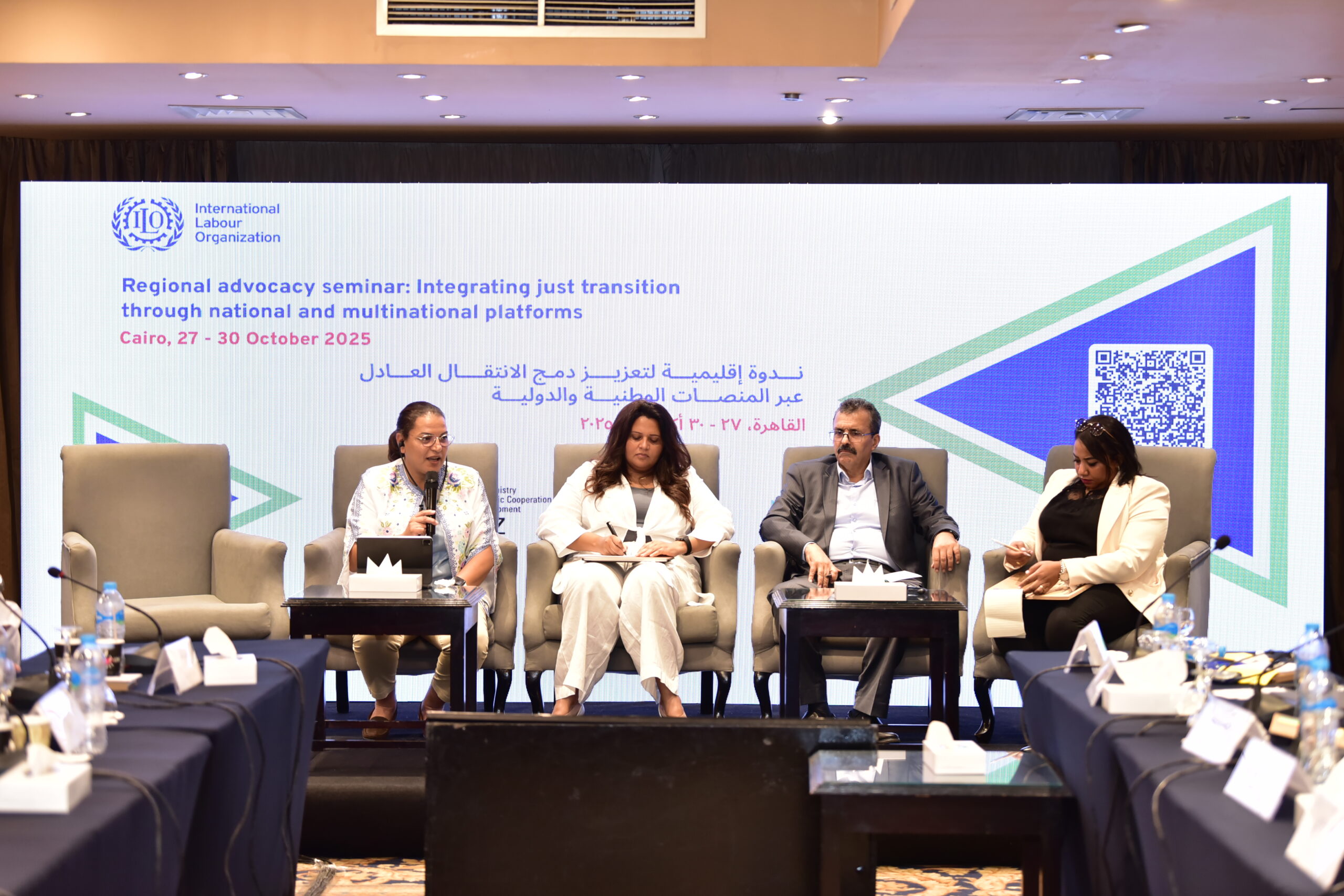
In October 2025, a regional advocacy seminar brought together Arab and African unions to share, learn and advance on just transition. This position paper is the outcome of the event
27 Oct 2025 - 30 Oct 2025
Regional advocacy seminar: Integrating just transition through national and multinational platforms | Actors: ECTU, ETUF (Egypt), UMT, UGMT, CDT (Morocco), NLC (Nigeria), ATUC (Jordan), UGTT (Tunisia), GFWTUI (Iraq), TUC (Ghana) | Workshop organized in collaboration with the ILO's regional office in Cairo. It was prepared ahead of COP30 in Belém, Brazil (November 2025) to present a unified Arab labour voice on climate and just transition issues.
Other stakeholders
Workers, youth, and women as central actors in a just transition, emphasizing their rights, vulnerabilities, and leadership roles

Workers: recognized as being on the frontline of climate impacts and economic restructuring, trade unions insist that workers must be protected through decent work standards, expanded social protection, and safe working conditions, and must be formally represented in climate governance and NDC processes. Informal workers, migrants workers and refugees are here explicitly included.

Youth: viewed as drivers of innovation and essential contributors to climate solutions. Unions call for structured youth participation through advisory platforms and representation in sectoral coordination bodies to ensure their ideas shape adaptation and mitigation pathways.

Women: trade unions advocate for gender‑responsive social protection, leadership roles for women in transition governance, and investment in the care economy as a source of green and decent jobs.